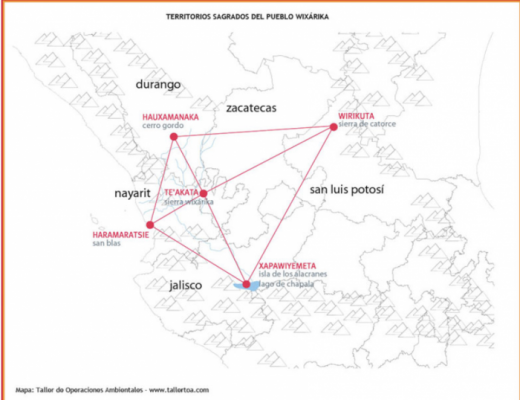
In what ways do Indigenous categories and practices challenge archaeological science? Many ancient materials and sites associated with Mexico’s Indigenous peoples form part of the subject matter of archaeology and are also ancestral and sacred places of a sensitive nature. However, despite this overlap, archaeological sites and sacred places are not interchangeable categories. This article by anthropologists Johannes Neurath and Antonio Reyes presents the results of the collaborative project “Catálogo de Lugares Sagrados del Gran Nayar” in Western Mexico, highlighting how Indigenous practices relating to these places resist academic classification and challenge archaeological understandings of monumentality, temporality, and aesthetics.
Biographical interview about anthropologist, Jay C. Fikes, who has dedicated his career and scholarship to Indigenous history and culture of the Americas--with a particular focus on Wixarika culture. This is part I of the interview.
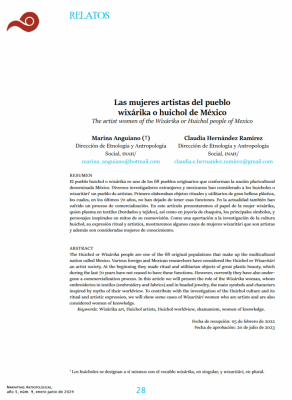
The Huichol or Wixárika people are one of the 68 original populations that make up the multicultural nation called Mexico. Various foreign and Mexican researchers have considered the Huichol or Wixaritári an artist society. At the beginning they made ritual and utilitarian objects of great plastic beauty, which during the last 70 years have not ceased to have these functions. However, currently they have also undergone a commercialization process.
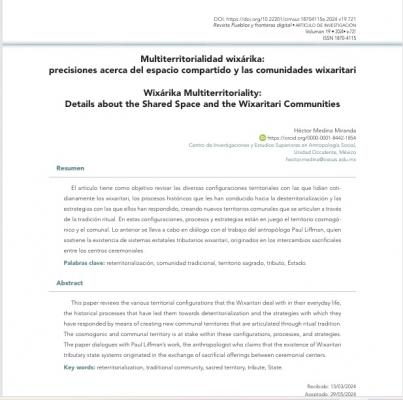
This paper reviews the various territorial configurations that the Wixarika deal with in their everyday life, the historical processes that have led them towards deterritorialization and the strategies with which they have responded by means of creating new communal territories that are articulated through ritual tradition. The cosmogonic and communal territory is at stake within these configurations, processes, and strategies. The paper dialogues with Paul Liffman’s work, the anthropologist who claims that the existence of Wixarika tributary state systems originated in the exchange of sacrificial offerings between ceremonial centers.
On September 22, 2021, six young Wixarika men between the ages of 16 and 32 were “disappeared” from a road that runs along the sinuous border between the western Mexican states of Jalisco and Zacatecas. Relatives and friends confirm that the young men had gone to carry out a traditional deer hunt. Within days, four of the six bodies were found bearing the marks of torture that are all too common in a country that acts as a hub for organized crime serving its northern neighbor’s notorious appetite for drugs.
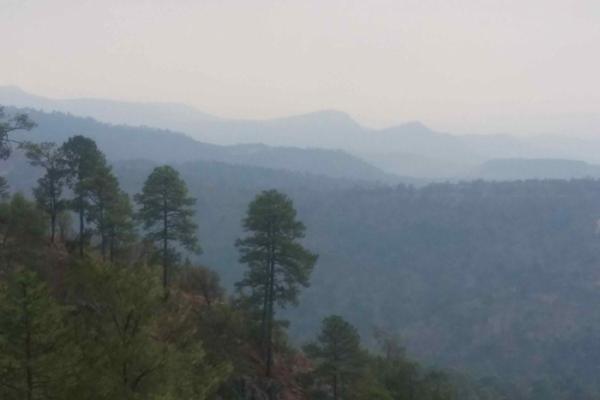
The Sierra Madre Occidental in northwestern Mexico boasts vast forests that are home to Indigenous communities such as the Wixárika people (or Huichols). Across the largest forest reserves in Jalisco, just three communities are spread across an area of more than 400,000 hectares (988,421 acres), equivalent to one-fifth the size of El Salvador. But this natural wealth is not reflected in the residents’ living conditions. Now, several stakeholders are coming together to help change this narrative.
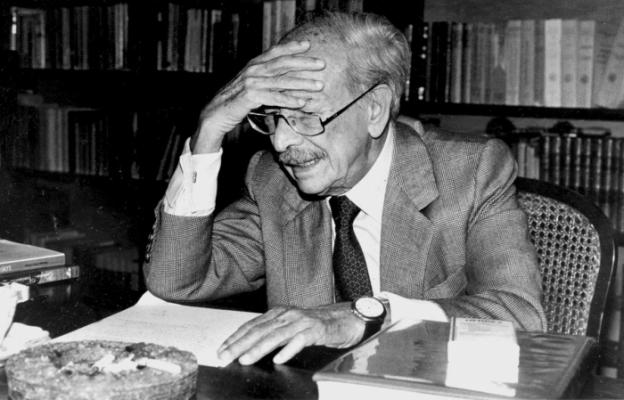
Fernando Benítez (1912-2000) was a journalist, anthropologist, writer, editor, historian, and a distinguished professor at the Faculty of Political Science, where one of the auditoriums bears his name. His work has been little studied in the 21st century. Benítez is considered the "father of cultural journalism" in Mexico.
María de la Concepción Sánchez Domínguez-Guillarte
| January 2020
"Although multiculturalism has contributed to the recognition of the rights of indigenous peoples, the reality is that there is a lack of mechanisms for these rights to be exercised. This article proposes an analysis of this situation from a specific case, Wirikuta, a sacred site of the Wixaritari, located in the desert, in San Luis Potosí, Mexico.
Abstract: Since 2010, the Wixarika (Huichol) indigenous people of western Mexico have struggled against transnational mining activity in their sacred pilgrimage site of Wirikuta in the semi-desertic plateaus of San Luis Potosi. This struggle has been accompanied by a multitude of non-indigenous and largely urban actors who have joined the Wixarika, bringing with them their own cultural, political and geographic registers for understanding and mobilizing against mining in the region.