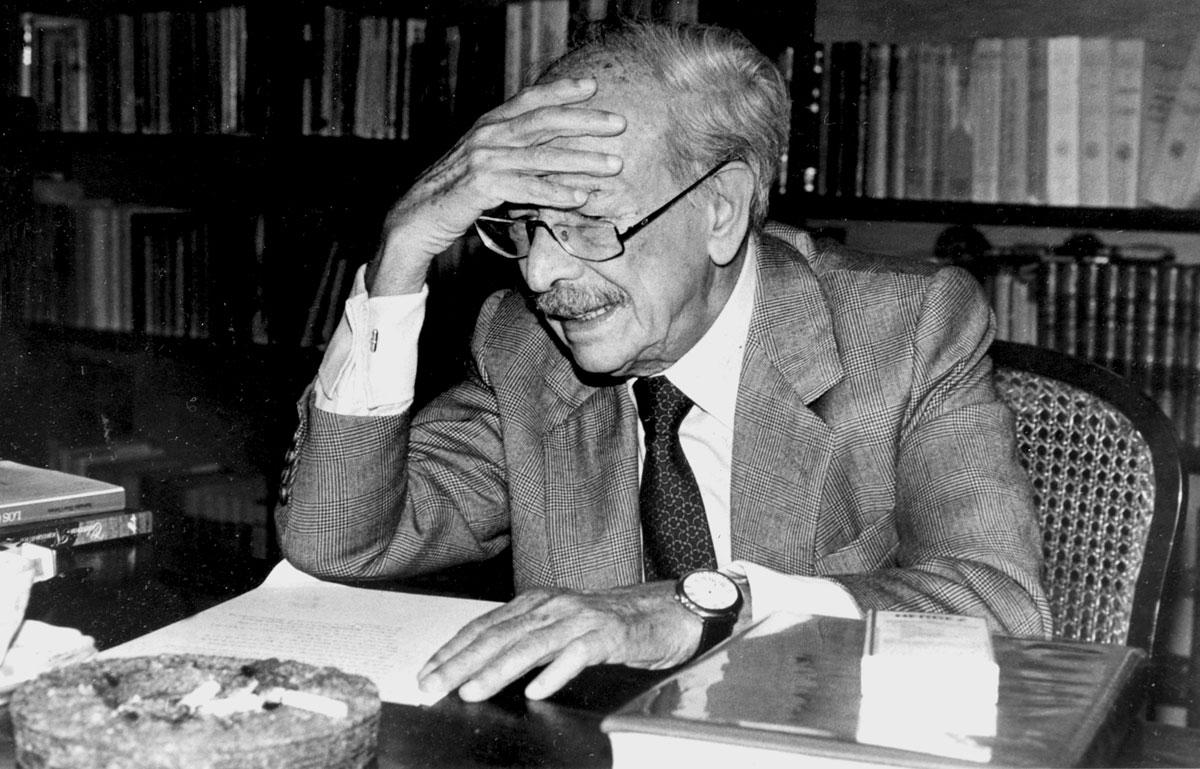
Other Inquisitions: Fernando Benítez
Fernando Benítez (1912-2000) was a journalist, anthropologist, writer, editor, historian, and a distinguished professor at the Faculty of Political Science, where one of the auditoriums bears his name. His work has been little studied in the 21st century. Benítez is considered the "father of cultural journalism" in Mexico. He dedicated his life to this profession from the age of 22. He began his career at Revista de Revistas (1934), where he worked for two years; he then became a reporter for the newspaper El Nacional (1936) and served as its editor in 1947. He was the director and founder of the cultural supplements Revista Mexicana de Cultura (1947), México en la Cultura, in the newspaper Novedades (1949-1961); La Cultura en México, in the magazine Siempre! (1962); Sábado, in Unomásuno (1977); and La Jornada Semanal, in La Jornada. (1987). In the field of essays, he wrote *The Route of Hernán Cortés* (1950), *Creole Life in the 16th Century* (1953), *Journey to the Tarahumara* (1960), *The Route of Freedom* (1960), *Lázaro Cárdenas and the Mexican Revolution* (1977), *The First Mexicans* (1982), *History of Mexico City* (1982), *Demons in the Convent: Sex and Religion in New Spain* (1985), and *The Manila Galleon* (1989). As a fiction writer, he wrote *The Old King* (1959) and *Poisoned Water* (1961). His work in journalism, anthropology, and literature was marked by his extensive contributions to culture, a task he undertook from a distinctly nationalist perspective and one deeply aware of the social problems facing the country.
Benítez was able to delve into both fiction and documentary, as evidenced in his work as a novelist and essayist. He received numerous awards for his work: the Mazatlán Prize for Literature (1969) for *Los indios de México* (The Indians of Mexico); the National Prize for Sciences and Arts (Linguistics and Literature, 1978); the National Prize for Anthropology (1980); the Manuel Gamio Medal for Indigenous Merit (1986); the National Prize for Journalism in Cultural Dissemination (1986); the Aztlán Prize (1989), awarded by the Government of Nayarit; the National University Prize for Teaching in Literature (1989); and the Medal for Civic Merit (1992).
The University of Guadalajara awarded him an honorary doctorate, and through the Guadalajara International Book Fair, he established the Fernando Benítez National Prize for Cultural Journalism. He received the Gold Medal (1993) for his contribution to culture, awarded by the State of Mexico; and the Order of Merit of Duarte, Sánchez and Mella (1994) in the grade of Grand Cross with Silver Plaque, awarded by the Government of Mexico. Dominican Republic, and the Gonzalo Aguirre Beltrán Medal (1997) for his anthropological work.
Undoubtedly, Benítez's most important work is a five-volume collection titled *The Indians of Mexico*, published by Ediciones Era starting in 1967. It represents a snapshot of the cultural diversity of this country, the result of more than twenty years of sporadic visits and living among various members of the ethnic groups that comprise it. The first volume (1967) is dedicated to the culture of the Tzotzil, Tarahumara, Tzeltal, Chamula, and Mixtec peoples; the second (1968) to the Huichol; the third (1970) to the Mazatec and Cora; the fourth (1972) to the Otomi and Maya; and the fifth (1972) to the Tepehuan and Nahua. The author's interest in the Wixaritari began with a journey he made to the region that They inhabited the region, and then he decided to delve deeper. Two texts taken from the volumes of the collection have been widely disseminated in Mexico and abroad; both deal with so-called entheogens: Hallucinogenic Mushrooms (1964) and In the Magical Land of Peyote (1968). The Huichol people, who call themselves Wixaritari, inhabit the region known as the Gran Nayar, the southern portion of the Sierra Madre Occidental that includes parts of Jalisco, Nayarit, Durango, and Zacatecas. Their language belongs to the Cora-Huichol branch, and he dedicated a volume to their culture. This work can be read as a travelogue and not only as a journalistic or ethnographic product.
To understand his work from the perspective of a travelogue, it is essential to define the term "journey," which should be understood as the movement from one physical space to another, almost always with a planned itinerary and chronology. Typically, the person undertaking the journey is from a society different from their own. Benítez is allowed to know. As a characteristic, this type of narrative involves the use of a series of emphatic elements that posit an economy of reality represented in terms of observation, testimony, and truth."
Read full length Spanish-language article here.