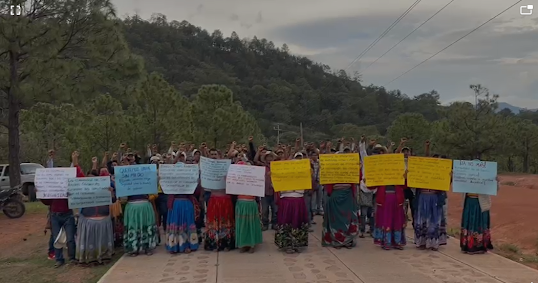
Tateikie Community Members Rebel Against the Jalisco New Generation Cartel and Insecurity
A gendarme fired into the air, bringing the crowd to a standstill; three hundred community members from Tateikie—also known as San Andrés Cohamiata, the northernmost Wixarika (or Huichol) community in Jalisco’s Sierra Madre Occidental, a region gripped by crime for at least five years—fell silent. The element of surprise aided the plans of Jalisco’s Secretary General of Government, Salvador Zamora Zamora; he boarded his helicopter and took off from the site known as El Bajío del Carrizal without addressing the community’s demands: specifically, to be freed from the crushing boot of the Jalisco New Generation Cartel (CJNG), which has dictated the lives of the mountain residents since at least the 2020 pandemic.
Still shaken by the official’s abrupt departure—he had spent two hours in the area but refused to wait for federal and municipal authorities from Mezquitic, as the Wixaritari had demanded—the community representatives broadcast a live statement on social media from the site of their protest.
“The community has issued an urgent appeal to all three levels of government—federal, state, and municipal—requesting their presence and the implementation of immediate actions to guarantee the safety, well-being, and peace of mind of the community’s families. This demand is rooted in the need for a comprehensive security and protection strategy to address the violence and insecurity affecting the population,” read a spokesperson for the indigenous territory. Recognized as spanning 74,940 hectares in November 1965, the community has lived for decades under pressure from de facto powers in Nayarit and Durango—resulting in massive land dispossession—and, more recently, has faced the onslaught of the criminal group founded by Nemesio Oseguera Cervantes, alias "El Mencho," who was killed by the Mexican army on February 22. The conflict erupted the previous Friday, September 4, after representatives of the communal landholders returned from being unlawfully detained by members of the criminal group; it was decided to station a large contingent of community members at the aforementioned location. "They said San Andrés belongs to the Jalisco Cartel and that everyone has to work with them; it’s been over five years, but we’ve reached our limit," confided a community member who asked to remain anonymous due to the obvious risk.
The call—the spokesperson continued during the broadcast—was directed at "authorities across all three levels of government, urging them to promptly come to the site and directly address the demands raised by the community. The community set a three-hour deadline [starting from the scheduled meeting time at El Bajío del Carrizal] for the relevant authorities to coordinate and formulate a joint institutional response to the insecurity issues currently facing the population... with the aim of fostering a direct, respectful, and solution-oriented dialogue with the competent authorities, seeking agreements and concrete actions to guarantee the safety of the people and the communal territory."
The Secretary of Government, Salvador Zamora, attended. "However, according to the community, the official left the site without comprehensively addressing the call made by community authorities and representatives—a situation that sparked dissatisfaction and concern among those present. The community believes that the presence of government representatives must translate into concrete actions, inter-institutional coordination, and direct attention to the issues raised, particularly given the severity of the insecurity."
A shot was then fired into the air to clear a path for the official’s departure, a move the protesters did not approve of. “The community states that it possesses evidence regarding the event in question; this evidence must be made available to the competent authorities so that the necessary investigations and proceedings can be carried out, and so that the facts and any resulting liabilities can be determined in accordance with the law,” the spokesperson warned.
Later that afternoon, speaking from Guadalajara, the agency led by Zamora Zamora stated that it is ensuring the community's safety through the presence of state and municipal police forces. While acknowledging “moments of tension,” the agency noted that communication channels remain open and that a secretariat representative will be present in the area as soon as municipal and federal representatives are appointed and arrive, allowing dialogue to begin.
In an eight-point list of demands, community members called for “the presence and effective coordination of all three levels of government” to “immediately address the insecurity issues affecting the community”—specifically, “the establishment of a comprehensive security and protection strategy for the population,” as well as “the clarification of the facts regarding the gunshot fired while Jalisco State Police officers were present” (the Indigenous residents are safeguarding the spent shell casing).
This includes a permanent roundtable between authorities and community members, as well as “the adoption of immediate measures to prevent further acts of violence and guarantee security conditions for the community’s families,” given that CJNG operatives roam the region freely.
UNDER THE BOOT OF CRIME
“The municipal police don’t help us; in fact, it is known that they are linked to them [the CJNG],” said an Indigenous man interviewed by *El Economista*.
“The cartel members have been around for a long time. They had detained some of our fellow community members—transport workers who travel to Huejuquilla—but the community rescued them. We then requested a federal government base, which was set up here with some military personnel; however, they cannot intervene to confront the cartel members, nor can they arrest them. We need a different kind of measure,” he explained.
The situation worsened with the onset of the pandemic nearly six years ago. “Because we are in a border zone—adjacent to Nayarit, Durango, and Zacatecas—and these territories were being contested by the Sinaloa and Jalisco cartels, we were hit hard; we are the community most affected by this issue. In particular, there have been robberies and abductions in the Canoas area [Durango], which is a mandatory transit point when traveling up from Huejuquilla; neighboring communities, such as Bancos de San Hipólito, also experience these robberies and abductions...”
This is not the first time they have protested against this state of affairs. In Jesús María—the administrative center of the Cora (Nayeri) community in the municipality of El Nayar—they also occupied public spaces, and for a time, they managed to reduce the pressure exerted by organized crime. “But it was temporary.”
Now, they have become accustomed to living under conditions that restrict their mobility and drive up the cost of daily life. “This situation significantly impacts the community’s economy—especially regarding healthcare supplies and ongoing school construction projects—as well as the resources delivered directly to the community for ‘artisanal road’ projects. Work is grinding to a halt because suppliers cannot enter the sierra; they have already had vehicles and machinery stolen. Consequently, they no longer want to work there, and those who do have raised material costs; right now, in Huajuquilla, the materials brought in are extremely expensive.”
For instance, he adds, “a 14-cubic-meter load of sand in a tandem-axle dump truck used to cost 16,000 pesos, but the price has risen to 20,000 pesos. The funds we receive from the federal government no longer go as far, and we cannot meet our road construction targets. This hurts us because the institutions tell us the reason doesn't matter; if we don't meet our goals, we lose funding for the following year. It is a major problem.”
Mobility issues affect other areas as well: “Regarding healthcare, when doctors are assigned here, they must travel under National Guard or military escort, and they require an escort when leaving, too. The same applies to the Federal Electricity Commission (CFE) when we request repairs for a power outage... if the National Guard isn't available, we end up without electricity, or without doctors and nurses.”
For the time being, the CJNG is recruiting indigenous Cora people from Jesús María—a move that baffles community members, as they were previously recruited by the rival cartel. “They enter the villages—even on foot—reach the grocery stores, and demand extortion payments. We haven’t given in to anything, and so, before the situation escalates further, we are calling on the relevant authorities to clear the community of them.”
— How can you be certain they are agents of the Jalisco Cartel, given the proximity of the conflict zone?
— They are indeed from Jalisco. They say it themselves: “We are the Jalisco New Generation Cartel and San Andrés belongs to us”—that is how they threaten us. According to the accounts given by the community representative, when he was kidnapped, they told him they intend to take over the entire community; they want to collect extortion fees—on businesses, livestock operations, and from teachers and beneficiaries of the *Sembrando Vida* program—basically anyone receiving funds. They want to appropriate those resources; they have stated this verbally. They tell us we’ll be fine—that if we just give them an opening and pay them, they won’t harm us.
The community members will maintain their protest at El Bajío del Carrizal but will march through the streets of Guadalajara this Monday morning to demand protection.