Recognition of the Wixárika Sacred Route Will Avoid the Pillage of Peyote
Mexico City. The inscription of the Wixárika Route through the Sacred Sites of Wirikuta as a UNESCO World Heritage Site, both cultural and natural, on July 12, during the 47th session of the World Heritage Committee, is “a strategic tool that strengthens the protection of Wirikuta and many other sacred sites along our ancestral routes to prevent their deterioration and destruction,” stated members of the Wixárika Regional Council for the Defense of Wirikuta.
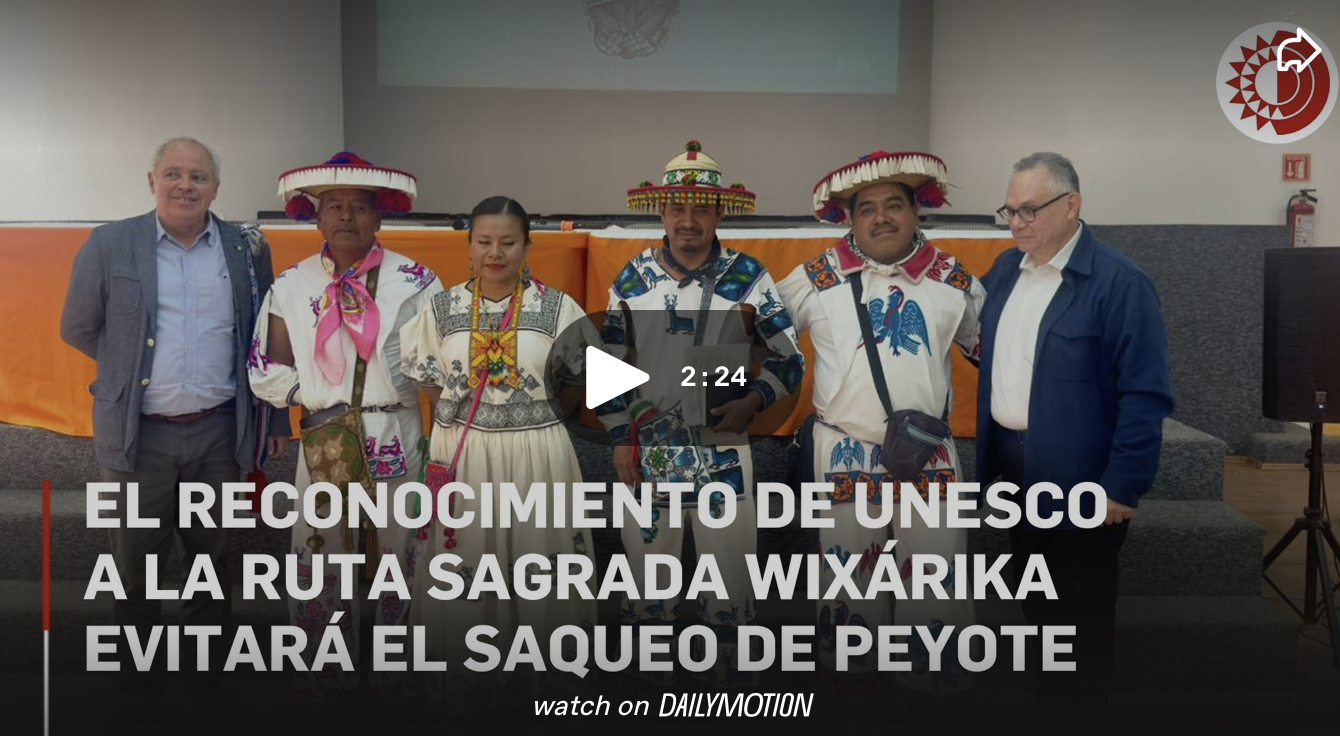
Traditional, civil, and agrarian authorities from the Wixárika communities that make up the Regional Council held a press conference at the Prodh Center, where they emphasized that the Council, along with its allies, has worked for years to achieve this international recognition and to publicize the importance of this work. Furthermore, this recognition “does not mean surrendering our ancient culture, but rather protecting it to prevent its plunder, commodification, and extinction.”
The inscription, in turn, “commits the Mexican State more than ever to providing sustainable development options for local inhabitants, to prevent the exploitation of the territory by agribusiness and extractive projects.”
The recognition, therefore, “obliges Mexico to increase its efforts in protecting peyote from the plundering by groups that do not belong to the Wixárika people, who have brought it to the brink of extinction.” The Regional Council demands, now more than ever, that Wirikuta and the other sacred sites be free from threats and that they provide dignified and sustainable opportunities for their inhabitants, stated Maurilio Ramírez Aguilar, general coordinator of the organization.
He was accompanied by Aurelio Torres Carrillo, commissioner of communal lands of Santa Catarina Cuexcomatitlán, Felipe Seriochino, representing the Wixárika community of San Sebastián and Tuxpan, and Sofía García Mijarez, communications coordinator.
The members of the Regional Council categorically reject the defamation and criminalization of our defense of sacred sites, as well as of its members, specifically our colleague Santos de la Cruz, since our defense is for life itself. We remember our comrades who lost their lives defending sacred sites.
In light of the new international obligations acquired by the Mexican State, the Regional Council demands the cancellation of all current mining concessions held by national and foreign companies in the Sierra de Catorce, the Wirikuta lowlands, and their surrounding areas. In 2010, 78 mining concessions were registered within this sacred territory.
The Council also demands that the Wirikuta Protected Natural Area in the state of San Luis Potosí be elevated to federal status. Simultaneously, it calls for the adoption of appropriate legal, scientific, technical, administrative, and financial measures to protect, conserve, and restore our sacred sites and ancestral pilgrimage routes.
Other demands include adopting a comprehensive policy to protect cultural and natural heritage in regional planning and development programs, developed with the participation of the inhabitants and the Wixárika people. They also demand “recognizing and supporting the Wixárika people’s ancestral forms of organization for the management, monitoring, and regeneration of our sacred sites, with an inclusive and participatory approach involving local residents.”
The Wixárika people are an ancient ethnic group located in the Sierra Madre Occidental mountain range, between the states of Jalisco, Nayarit, Durango, and Zacatecas. In 2010, their population numbered 44,788. Wirikuta is a sacred site of paramount importance to the Wixárika people, located in the municipalities of Catorce, Charcas, Vanegas, Villa de Guadalupe, and Villa de la Paz, in the state of San Luis Potosí.
The Wixárika people make pilgrimages from their communities, traveling more than 400 kilometers, visiting various sacred sites to perform their ceremonies before arriving at Wirikuta. It is also an area of high ecological value, due to its biodiversity and the environmental services it provides to society as a whole. However, it is threatened by open-pit mining to extract silver and other precious minerals.
Among UNESCO's recommendations are: prohibiting mining activities; ensuring rights of way and transit; and providing dignified work activities that “do not affect health.”
The legal protection of the site is guaranteed by various federal and state laws. The National Institute of Anthropology and History (INAH) is the federal agency responsible for the conservation of cultural heritage.
At the end of the press conference, Francisco Vidargas, INAH's Director of World Heritage and Cultural Focal Point to UNESCO, reported that in 2026 they will receive the certificate of inscription from UNESCO, so that from this point forward, “it will be established which of the Wixaritari communities will be responsible for its upkeep.”